Symphony · 2004
Symphony 1: The Seven Wonders of the Ancient World
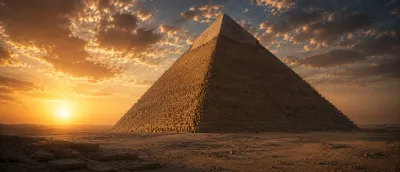
In the Ancient World the seven most beautiful monuments were called ‘The Seven Wonders of the World’.
Symphony No. 1 paints a musical portrait of these splendid structures, now — but for one — all destroyed.
Movements
- IThe Temple of Artemis The opening movement of the symphony consists of three themes. The main theme, which is also the opening theme, depicts the impressive sight of the temple. The temple, after all, was made up of 127 columns, was 130 metres long and 20 metres high, and was entirely clad in marble. The second theme (which enters from the 3/4 bar) is the hunting theme. The goddess Artemis was a symbol of the hunt, nature and fertility. The hunting theme leads into a fully orchestrated passage symbolising the beauty of nature. After the return of the hunting theme, the movement ends with the sight of the temple.
- IIThe Great Pyramid of Cheops The best-known wonder of the world is surely the Pyramid of Cheops. It is also the only wonder still standing. This movement of the symphony begins with a cluster in the bass register, in which the cellos and timpani make glissandos. This depicts the oppressive heat of the desert. The clarinets, saxophones and flutes blow through their instruments while holding the fingerings of the notated notes. This makes the instrument larger or smaller, so that very soft pitches can be heard. This symbolises the minute changes the wind makes to the sand of the desert. In the distance the pyramid appears on the horizon. The passage that follows is the building of the pyramid. The dragging of the stones and the laying of the successive courses can be found literally in the score; each time a new group of instruments forms a layer on the pyramid. The main theme now enters. A soft passage with whip cracks alludes to the question of whether the pyramid was built by slaves. The piece ends once more in the heat of the desert.
- IIIThe Statue of Zeus Zeus is the supreme god of all the Greek gods and also the god of lightning. This movement is a character portrait of Zeus. It begins with an extreme fit of rage, something that often comes over Zeus when things do not go his way. The thunder sheet naturally depicts the bolts of lightning Zeus hurls down to earth. This theme flows into a theme portraying the power of Zeus, performed both legato and marcato. Then, after a fast, soft passage with loud lightning strikes, the trombones and low horns introduce a new theme representing the pride of Zeus. The Greek gods lived on Olympus, a mountain that reached into the clouds. Olympus was often attacked by evil monsters, and Zeus always led the battle whenever it was attacked. The 9/8 passage depicts this. Zeus and the gods overcome evil and the victory theme enters. The piece ends with the opening theme.
- IVThe Mausoleum at Halicarnassus The whispering of the dead and other tomb sounds introduce this movement. It portrays the contrast between the building’s function and its beauty: the mausoleum was a tomb for the king of Halicarnassus, yet it was a magnificent, gold-clad building. After the singing and the solo passages in flute and clarinet, the main theme — depicting the beauty of the wonder — comes to the fore. This theme is followed by the funeral procession that escorted the king to his grave. The movement ends with the main theme.
- VThe Hanging Gardens of Babylon This movement is the resting point of the symphony. The Hanging Gardens of Babylon are described in the literature as the most beautiful gardens ever laid out. The gardens consisted of several terraces connected to one another by stairways. Besides the most exotic species of animals and plants, water played an important role in the gardens. Poets of the time wrote of streams flowing upward and silent waterfalls. No remains of these gardens have ever been found, and it is highly questionable whether they ever existed at all, and if so in what form. This movement of the symphony therefore begins and ends with mysterious sounds. Various blocks of sound flow into one another, depicting the terraces of the garden. The middle section is soothing and shows the beautiful flora and fauna of the various terraces.
- VIThe Lighthouse of Alexandria A lighthouse 112 metres high that became famous for its ingenious system of mirrors. At night a great fire burned, and by day the sun was reflected by the mirrors. This allowed ships to see Alexandria from afar. The opening of the movement depicts a calm sea in which the light of the lighthouse is reflected. Two horns and a euphonium portray the sunset. At night a storm rises; material from the third movement (Zeus, the god of lightning) takes on the lighthouse theme. In the end the lighthouse theme prevails and the sun rises. The ship approaches the harbour and the tall tower draws nearer. The lighthouse theme reaches its climax as the risen sun illuminates the lighthouse.
- VIIThe Colossus of Rhodes A statue many metres high, built entirely of bronze — that was the Colossus of Rhodes. This gigantic structure stood in the harbour, and legend has it that ships even sailed beneath the statue to dock at Rhodes. This movement begins with the forging of the colossus, in which the anvil accordingly plays a large part. After a powerful opening chord — which is also a reference to the movement’s main rhythm — the colossus is built up. The first build-up is followed by a woodwind passage alternating with the bass section. The 7/8 rhythm then returns. Themes from the first six movements are repeated chronologically, forming a retrospective of the wonders already encountered. After these reflections the colossus theme returns, and the work closes with the main theme from the first movement, with the timpani solo from the fourth movement beneath the final chord.
Upcoming
- Philharmonie Nijmegen · Lex Bergink Event page
- Studenten Harmonie Orkest Twente · Ronny Buurink
Performances
- Wilhelmina Glanerbrug · Hennie Ramaekers, Ronny Buurink & Arnold SpanPremiere
- Banda Musical de Fajões · Bruno Costa Watch on the community wall →
- Isselburger Blasorchester · Jaak Notebaert Watch on the community wall →
- Banda Musical de Fajões · Bruno Costa Watch on the community wall →
- Muziekvereniging TOG Welten · Txemi Etxebarria Watch on the community wall →
- Knightwind Ensemble · Erik N. Janners Watch on the community wall →
- Orchestra di Fiati della Svizzera Italiana (OFSI) · Daniele Giovannini Watch on the community wall →
- Feng Chia, National Tsing Hua & National Dong Hwa University Wind Bands · Lü Yen-Ching (呂彥慶) Watch on the community wall →
- Symphonic Wind Orchestra of Maribor Conservatory of Music and Ballet · Damijan Kolarič Watch on the community wall →
- Banda Musical de Fajões · Bruno Costa Watch on the community wall →
- Studenten Harmonie Orkest Twente · Ronny Buurink Watch on the community wall →
- Koninklijk Erkend Harmonieorkest L’Echo des Montagnes · Geerd Doomen Watch on the community wall →
- Banda Musical de Fajões · Bruno Costa Watch on the community wall →
- Gruno’s Postharmonie Groningen · Peter Kleine Schaars Watch on the community wall →
- Musikverein “Viktoria” Altenmittlau · Hans Rückert Watch on the community wall →
- Muziekvereniging Excelsior Wassenaar Watch on the community wall →
- Chang Gung University Wind Band (長庚大學管樂團) Watch on the community wall →
- Banda Municipal de Música de Vitoria-Gasteiz · Iker Olazabal Watch on the community wall →
- Tata Steel Orkest · Hennie Ramaekers Watch on the community wall →